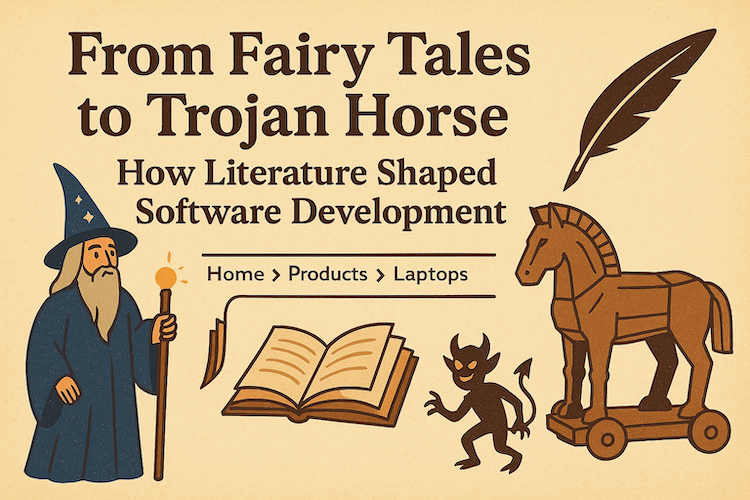
TL;DR - Software terminology is steeped in literature and myth: breadcrumbs (Hansel and Gretel), README (Alice in Wonderland’s “DRINK ME”), daemons (Greek myth and Maxwell’s Demon), wizards, oracles (the Oracle of Delphi), and trojan horses (The Iliad). We borrow these names because metaphor is how humans make sense of complex systems.
By day, I write JavaScript. By night, I vanish into fantasy and sci-fi-worlds where wizards whisper secrets, and demons run invisible errands.
Turns out, those worlds aren’t so different.
The web is full of metaphors lifted straight from literature: breadcrumb trails, daemons, wizards, oracles, trojans. Even README files that might as well say “DRINK ME.”
As someone who builds interfaces and devours speculative fiction, I find it fascinating-and honestly, beautiful-that our field is shaped by stories. Not just figuratively, but literally: the terminology, concepts, and metaphors we use to build and discuss software are steeped in centuries of storytelling.
Let me show you.
Breadcrumbs: Hansel and Gretel, but Make It UX
You’ve seen them before:
Home > Products > Laptops > Gaming > RGB Overkill 9000
That’s a breadcrumb trail, a direct nod to Hansel and Gretel. In the fairy tale, the children drop breadcrumbs in the forest to find their way back home.
In UI design, it’s the same idea. The metaphor is more than cute-it’s intuitive. Breadcrumbs tell you where you are and how to retrace your steps. The name comes straight out of a story, and the mental model works because the story is already familiar.
README: Wonderland-Inspired Dev Culture
Every repo has a README.md. Every README says, “READ ME.” It’s a command, an invitation.
Its roots trace back to Alice’s Adventures in Wonderland, where Alice finds bottles and cakes labeled “DRINK ME” and “EAT ME,” each changing her reality in unpredictable ways.
Early UNIX hackers loved the reference. “READ ME” became the perfect prompt for exploring something strange-possibly transformative. That tradition still lives on.
Daemons: MIT Meets Mythology
In Unix, a daemon is a background process handling system-level tasks without user interaction.
The term was chosen deliberately. It nods to Maxwell’s Demon, a physics thought experiment about an invisible entity managing energy, and to the Greek daemon (δαίμων)-a guiding spirit between mortals and gods.
At MIT in the ’60s, programmers liked the image of tireless little spirits working behind the scenes. The result: a bit of mythology baked into sysadmin vocabulary.
Wizard: Magical Setup Assistants
Software “wizards” are multi-step setup dialogs that walk you through installing or configuring something. The name is pure fantasy-a knowledgeable guide helping you through something complex.
And when we prototype a system using a human to mimic the backend? That’s a Wizard of Oz test, straight from L. Frank Baum’s story where the mighty wizard is just a man behind a curtain.
Oracle: From Delphi to Databases
In the 1970s, a CIA project to build a relational database capable of answering intelligence queries was codenamed Oracle.
The metaphor stuck. In ancient Greece, the Oracle of Delphi was where people sought divine answers. The tech version simply added SQL, indexing, and version control.
Today, “Oracle” is both a company and a concept: a system that stores knowledge and reveals it-if you know the right query.
Trojan Horse: Malware in Disguise
Everyone knows this one-a seemingly legitimate program that smuggles malicious code into your system.
The name comes from The Iliad: the Greeks’ wooden horse concealing soldiers inside, used to sack Troy. Different battlefield, same tactic.
So What?
If you love fantasy or sci-fi, you’re already halfway to understanding the way developers talk. Our field is soaked in metaphor because metaphor is how humans understand complex systems.
We call background processes daemons because that makes them less abstract. We name navigation aids breadcrumbs because that mental model already exists. We label instructions README because it echoes a magical invitation in a strange world.
These aren’t just names-they’re cultural artifacts. They’re proof that the code we write is still shaped by the stories we grew up with, and by the ones we continue to tell.